S³ Brief October 2026

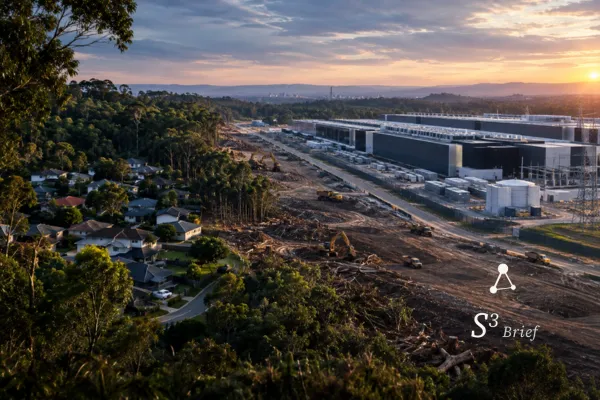
Build First, Permit Later.
New Jersey recently issued its largest fine against a data centre: US $1.07 million, for running 62 generators without permits. The site serves a US $17.4 billion contract, and against that the fine is immaterial.
For leaders accountable for essential services, critical infrastructure or emergency management, this matters: these facilities draw on the same grid, fuel, water, and planning capacity their organisations rely on.
Versions of this are occurring across Australia, Asia, and Europe. Data centres are being built faster than the rules written to govern them, and penalties, where they exist and are applied, are small enough to absorb as a cost of doing business.
Signal Scan
Australia: Data centres use about 3% of grid-supplied electricity. The Australian Energy Market Operator (AEMO) forecasts around 6% by 2029-30 and 12-13% by 2035-36. Its books show how speculative the pipeline is: more than 18 GW of data centre enquiries in the 18 months to October 2025, around 2.2 GW in the formal connection process by March 2026, and around 36% of projects listed a year earlier since cancelled.
The connection queue is full. Data centres were told in August that Sydney had sold out of electricity capacity. Transgrid has signed agreements for 1.5 GW of new demand in western Sydney, effectively doubling load there, and has received 20 GW of large-load enquiries against average New South Wales demand of 7.5 to 10 GW. Capacity goes in the order customers sign and fund upgrades. Sydney's next major transmission project is due in two stages, in 2030-31 and 2033-34.
Who pays is contested. The federal Energy Minister has asked the Australian Energy Market Commission (AEMC) to change the rules, arguing some connection costs could be recovered from other consumers. Victoria's position is that existing rules already have the party creating the demand pay for its connection. New South Wales is proposing reforms, so data centres impose no net cost on other customers. Submissions to the AEMC close on 5 November.
Water is the next queue. Data centres currently draw less than 1% of drinking water across Melbourne and Geelong. Greater Western Water is assessing 19 applications seeking a combined 19,714 megalitres a year, roughly 4% of Melbourne's supply.
Rules are coming. National Cabinet has agreed mandatory national standards, with Commonwealth legislation intended for early 2027. Victoria is introducing a data centre land-use category and a 150-meter buffer from homes. South Australia has announced a royal commission.
Tasmania shows how build first may potentially play out. Firmus Technologies' three Tasmanian projects would use 444 MW, making it the state's largest power user. George Town Council approved its 288 MW data centre after the state's Environment Protection Authority (EPA) determined no environmental assessment was needed. A condition limits its 276 diesel generators to emergencies and routine inspections. Firmus has appealed to the Tasmanian Civil and Administrative Tribunal (TASCAT) to run them during energy market stress, and the EPA has now applied to join. At approval, the Premier said he did not want guardrails to become too restrictive.
At Wesley Vale, where Firmus's 52MW application is yet to be approved, Latrobe Council is assessing whether excavation went beyond the site's approved forest practices plan. The mayor described transportable buildings, piles of dirt and blue metal on site. Firmus says the work is general maintenance that needs no planning approval and has paused while the council assesses. The council has asked the state to assess the project as a major project. A parliamentary inquiry has received 152 submissions, and six further projects are being explored.
APAC: Thailand approved 88 AI and data centre projects worth 886 billion baht in the first half of 2026. On 4 September it suspended construction of 49 while it writes new rules, with 117 more awaiting investment approval. Bangkok's governor said complaints about a data centre being built next to a hospital exposed a gap that lets these facilities seek permits as warehouses. Energy officials separately removed about 200,000 litres of fuel stored without a licence at a Bangkok data centre.
In Japan, Inzai residents are in court against a proposed data centre. Critics say building rules can classify data centres as offices, outside industrial controls and the residents' lawyer says the law is not catching up. This is particularly relevant for diesel storage limitations.
In New Zealand, Singapore-owned Datagrid gained overseas investment approval and consents, without public input, for a Southland facility. After local opposition, it is redesigning around a large battery system, cutting backup diesel generators from 84 to about 10 and dropping groundwater cooling.
Global:
The scale is unprecedented. PricewaterhouseCoopers puts global data centre spending at US $31.6T through 2050. Research group Data Centre Watch found at least 75 projects worth about US $130B blocked or delayed by local opposition in the first three months of 2026.
In Finland, the Licensing and Supervision Authority ordered Google's project company to suspend site works at two sites in a €13B programme by 23 October. About 330 hectares of forest was felled at Muhos, and close to 200 hectares logged at Kajaani, before the environmental impact assessment was complete. The regulator listed tree removal, topsoil stripping, and site roads, and says it will consider enforcement and a fine if the order is ignored. Google said it had "fallen short of its own standards and acted in good faith under forestry law."
In New Jersey, a similar sequence is documented. The state inspected the Vineland site on 29 July. The city issued stop work orders on 6 and 10 August for building without a construction permit. The 62 generators totalled about 123 MW, and while the site's approved capacity was 300 MW, the developer now lists 350 MW.
In Mississippi, the ranking Democrat on a US Senate committee alleges xAI ran gas turbines without Clean Air Act permits. At its first site, the turbines were removed only after a state permit for permanent units was granted. At the second, the state approved permanent turbines.
For US tax purposes, Meta classifies its AI data centres as experimental "pilot models" to claim a research credit created in 1981 to reward genuine experiments, according to the New York Times. Savings from that credit cut almost US$4 billion from its tax bill last year.
Shock Watch
Prioritisation: Essential service and critical infrastructure expansions planned for this decade are competing for capacity that, in Sydney, grows only in the next. Queue position is set by who signs and funds first, and speculative load sits in the same queue as the upgrades communities depend on.
Stranded costs: New South Wales has around 13 GW of data centre load in advanced connection talks, against industry's own forecast of 3.9 GW by 2030. If networks build for load that never arrives, the Minister's rule change request says that other customers could pay. Tasmanian researchers add a second risk: a grid leading on a few customers from a single industry carries concentration risk and could leave the state paying for under-used infrastructure.
Backup becomes supply: Australia held 32 days of diesel cover at 29 September. A single proposed Sydney campus at Horsley Park includes 120 generators and about 4,472 tonnes of stored diesel. Generators approved for emergencies, if run during market stress, draw on the same supply market essential and emergency services rely upon. New Zealand's redesign shows batteries can carry much of that load.
Water and heat: The pending Melbourne applications land as a forecast record El Niño builds, with the World Meteorological Organization (WMO) expecting a December peak. Cooling, firefighting, and household demand will peak in the same months.
Sensemaking
When a penalty costs less than waiting, building first and seeking approval later becomes a commercial choice. That same sequence is repeating across multiple systems.
The available timelines make it structural. Data Centres Australia say a data centre takes 18 months to two years to build, while a new renewable energy project takes four to seven. The federal requirement for data centres to bring new renewable supply widens that gap. Waiting for power or permission costs years, so the incentive to move first is built into the system.
Categorisation is largely based on legacy rules. A data centre can be classified as a warehouse in Bangkok, an office in Japan, and an experiment on a US tax return. In Tasmania, generators approved as emergency backup are now sought for market stress.
Another point easily lost in these narratives: the company pushing boundaries is a step away from the big name. DataOne built the New Jersey site for Nebius which holds the Microsoft contract. Tuike Finland acts for Google. The University of New South Wales (UNSW) AI Institute makes the same point to Tasmania: the company holding planning approval is rarely the one controlling the computing capacity, so obligations need to carry through leases and connection conditions to the tenants who do.
Approval systems make the pattern harder to see. The Digital Infrastructure Institute notes that facilities are assessed one application at a time while their effects add up, and commitments are judged on what is promised at approval, before anything operates.
Governments are promoting development while regulating it. Both roles are legitimate; however, the examples here show regulation running well behind.
Australia has seen this pattern before, in resources. Overseas capital using local land, water, and grid capacity, while local communities and infrastructure carry the load for the long term. The difference this time is speed and capacity to pay.
Interdependencies
The draw on grid, water, and diesel is cumulative, and it lands on the same systems every business and household rely on. Left unchecked, it will change local systems in ways that are hard to reverse.
Decisions made now will shape conditions locally, regionally, and nationally for decades to come. Deep pockets bring influence, and the capacity to build first and ask forgiveness later.
Fuel links these facilities to disruption and emergency management. In March, hundreds of service stations ran out of at least one fuel type in a single week, attributed to demand and distribution. Transport operators told drivers to top up whenever they saw diesel. Large backup holdings topping up in a similar squeeze would compete with emergency and essential fleets.
In Tasmania, 6,000 people signed a petition against the Bell Bay proposal and more than 9,000 called for a moratorium. Where opposition delays projects, the schedule risk spreads to everyone planning around the same grid and water.
Councils assessing these projects are often the same bodies responsible for local emergency management. Finland's nature conservation association pointed to small municipalities overwhelmed by the pace.
The levers already exist inside organisations: conflict-of-interest provisions in delegations, risk oversight of third-party dependencies, and conditions in connection and supply agreements. Victoria's planning law already allows orders that strip the commercial benefit gained from a permit breach. Where that power is used, the gap between a fine and a contract closes. The key is to use these levers before approval, while leverage is strongest.
Questions for Leaders
Which growth plans assume a grid or water connection before 2030-31, and what happens if that assumption fails?
If network costs from delayed or cancelled data centre loads are recovered from alternate customers, what is the exposure, and who is tracking the rule changes?
When a development creates both benefits and impacts for the organisation, how is that tension surfaced and managed?
What Matters Next
30 days: AEMC submissions on network cost recovery close on 5 November, and large network customers can make one. Watch whether Finland's 23 October deadline leads to a fine.
90 days: Watch TASCAT on the Firmus generator appeal, Thailand's national standards, the Tasmanian inquiry's findings and New South Wales' no-net-cost reforms.
12 months: Commonwealth legislation sets the national floor in early 2027. Test whether your approvals and supply agreements carry conditions that flow through to the tenants who control the load.
Key Sources
Tasmania's EPA worried AI company Firmus plans to use generators much more than first disclosed
Thailand suspends 49 data centres amid resource concerns | The Straits Times
How Meta uses AI data centers to avoid billions in federal taxes | The Seattle Times
Opposition to data centers grows in cramped urban Japan - The Japan Times
New transmission capacity in Sydney to be funded by data centres | Transgrid
This post is the full S³ Brief. A snapshot runs as a LinkedIn Newsletter. Subscribe to receive the full S³ Brief direct to your inbox. [subscribe here]
Working through complexity in your organisation? reach out [enquiry form]


